- ① Insert 3 advance-praise quotes: uncomment the block below; each needs the reader's permission + attribution preference. (None captured yet; see production/launch-copy.md.)
About the Book
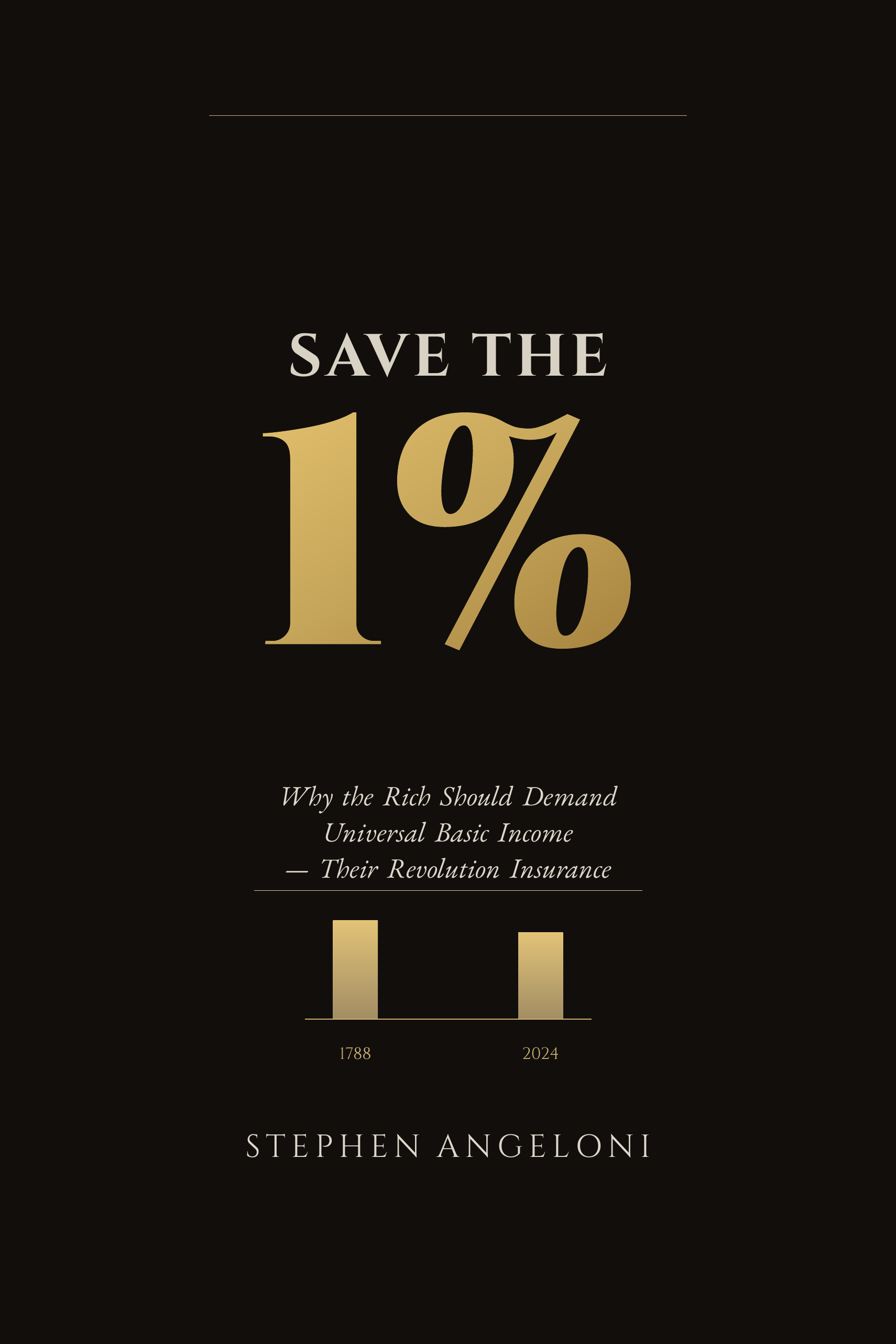
A security consultant lays a single chart on a billionaire's kitchen counter. Left column: France, 1788. Right column: the United States, today. The numbers are almost identical. That is the problem.
When the top of society owns everything and the bottom owns nothing, history offers one reliable outcome. Now artificial intelligence is about to remove the economic value of most human work, permanently. Save the 1% makes the counterintuitive case that Universal Basic Income is not welfare, not charity, and not a left-wing program. It is revolution insurance, and the people who should want it most are the ones with the most to lose.
Working from history, macroeconomics, and game theory, Stephen Angeloni eliminates every alternative (job guarantees, robot taxes, shorter weeks) before arriving at the only mechanism the math supports. This is the case for redistribution made not on fairness, but on self-preservation.
About the Author
Stephen Angeloni is a financial IT consultant who has spent thirty-five years convinced that universal basic income is where advanced economies must eventually arrive. He is not an economist. He reasons from incentives, from the arithmetic of who pays for what. His question is simple: what holds a society together when most people no longer have an economic stake in it? Save the 1% is his first book. He writes on the economics of automation at savethe1percent.com.
Comparable Titles
Thomas Piketty, Capital in the Twenty-First Century · Daniel Susskind, A World Without Work · Andrew Yang, The War on Normal People · Yuval Noah Harari, Homo Deus